"Tell me about yourself." — Interviewer ne aap se ye sawal pucha, aur aapki saans ruk gayi. Aapke dimaag me itne saare answers bhaag rahe hain ki aap kahan se shuru karein hi nahi samajh pa rahe. Jo cheezein aap roz apne kaam me confidently karte hain, wo interview room me bolne ke liye kyun itni mushkil lagti hain? Sach ye hai ki interview ek knowledge test nahi, ek practice test hai — aur 90% candidates kabhi rehearse nahi karte. Jo log rehearse karte hain, wo hi offer letters le jaate hain.
Main aapko ek real scene batata hoon. Rahul, 4 years ka QA engineer, technically brilliant — bugs wo aise pakadta hai jaise koi aur nahi. Usne 6 companies me interview diya, sab me rejection. Wajah? Uske paas answers the, par structure nahi tha. Wo "humne ye kiya, phir wo kiya, result achha aaya" bolta tha — bina numbers, bina story. Phir usne apne answers ko STAR format me todna seekha, har question ka rehearsal kiya, aur agli interview me 3 offers. Same knowledge, bas delivery badal gayi. Isi transformation ke liye ye guide hai — aur saath me ek free Interview Prep Studio bhi, jo aapke role ka 12-question rehearsal pack 5 second me bana deta hai.
Is guide me hum cover karenge: interview me kya actually hota hai (interviewer ki nazariye se), STAR method ka poora breakdown real examples ke saath, sabse common 12 behavioral questions aur unke answer frameworks, freshers vs experienced ke liye alag strategy, practice ka 7-day plan, video interview ke tips, aur wo mistakes jo aapko offer khone pe daal deti hain. Chai lo, aur shuru karte hain.
Interview Me Hota Actually Kya Hai — Interviewer Ki Nazar Se
Interview crack karne se pehle samajhna zaroori hai ki interviewer ka goal kya hai. Wo aapka resume dobara padh nahi raha, wo aapke resume ke claims ko verify kar raha hai. Har sawal ek probe hai: "Aapne resume me likha hai ki aapne team lead ki — prove karo, kaise, kitne log, kya result?" Interviewer ke paas aapke resume se 3 questions aur aapke answers se 30 follow-ups hote hain.
Doosra sach — interviewer aapko reject nahi kar raha, wo select kar raha hai. Ye subtle difference mindset badal deta hai. Companies ke paas role hai jo unhe fill karna hai, aur har interview me wo hoping hote hain ki "kaash ye banda sahi nikle." Aapki job unki hope ko saabit karna hai — structured answers ke saath. Jab aapka answer clean aur organized hota hai, interviewer ka dimaag ye signal process karta hai: "ye banda prepared hai, organized sochta hai, communicate kar sakta hai" — aur ye teen signals hi hiring decision ka 70% hissa hote hain.
Teesri baat, jo sabse zyada log miss karte hain: interview me silence aapka dushman hai aur rambling bhi. Ek ideal answer 90 seconds ka hota hai — chhota nahi ki detail missing ho, lamba nahi ki interviewer bored ho jaye. Ye 90-second timing sirf practice se aati hai. Aur practice ke liye hi humara tool hai — Interview Prep Studio aapko apne role ke exact questions deta hai jinka rehearsal karna hai, taaki real interview me koi bhi question aaye, aapke paas structure ready ho.
Interview Questions Ke 3 Types — Kaunsa Kab Aata Hai
Har interview ke sawal 3 buckets me aate hain, aur har bucket ki apni taiyari hoti hai:
| Type | Example | Kya check hota hai | Kitna % interview me |
|---|---|---|---|
| Technical / Domain | "REST vs GraphQL kya difference hai?" | Aapki craft knowledge | 30-40% |
| Behavioral | "Ek conflict batayiye jo aapne handle kiya" | Past behaviour (future ka predictor) | 40-50% |
| Situational / Case | "Client har week scope badal raha hai, kya karoge?" | Thinking process on the spot | 15-20% |
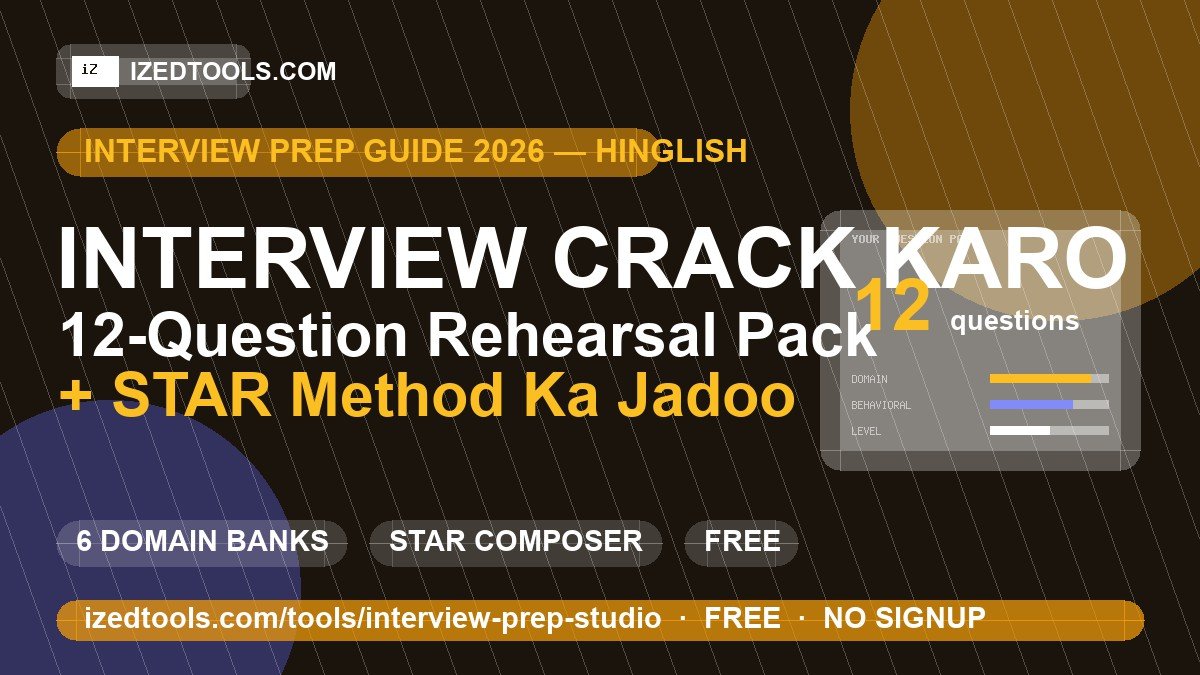
Zyada tar log sirf technical prep karte hain — DSA ratta maar le, framework ke docs padh le — aur behavioral round me unconsciously rehearsal ke bina jaate hain. Galti yahi hoti hai. Behavioral round me interviewer ke paas script hota hai: "Tell me about a failure, a conflict, a deadline, a leadership moment" — aur ye questions 6 domain banks me categorize ho chuke hain industry me. Hamara tool in 6 banks se aapka pack bana deta hai: Design, Engineering, Data, Marketing, Product, Sales — aapke role match hone pe sahi bank se 5 domain questions + 5 universal behavioral + 3 level-specific (fresher ya leadership) = 12-question rehearsal pack.
 STAR Method — Har Behavioral Question Ka Master Formula
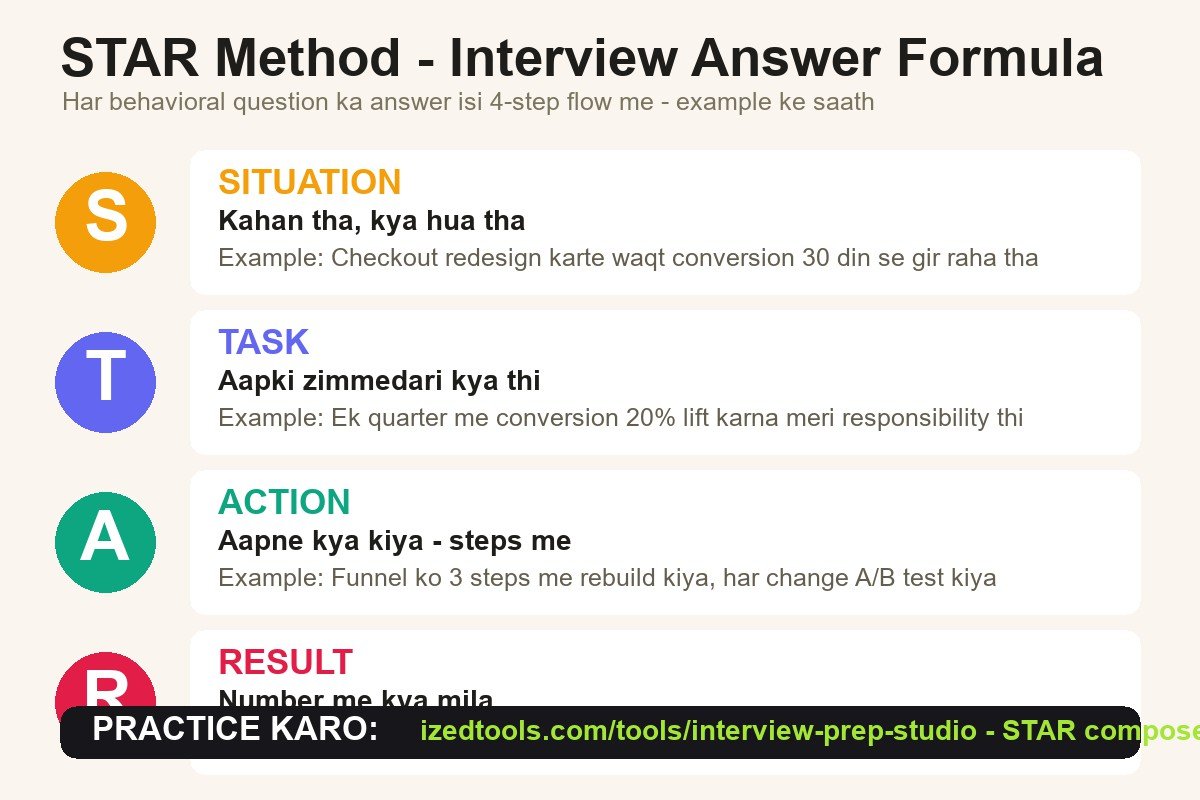
STAR ek framework hai jo behavioral answers ko 4 parts me todta hai — Situation, Task, Action, Result. Ye acronyms ke bade bade lecture internet pe mil jayenge, par main aapko kitchen-table version deta hoon: STAR ka matlab hai "story me se pani nikal do." Aapki story 90 second ki clean movie ban jaye — background, aapka role, aapke steps, aur end me number.
S — Situation (30 seconds max)
Background set karo — kahan tha, kya hua tha. Ek line me. "Meri pichhli company me hamara checkout flow pichhle 30 din se conversion gir raha tha" — bas. Yahan log 2-minute ka backstory suna dete hain (team structure, office politics, project history) aur interviewer ka attention mar jata hai. Rule: agar aapka Situation 2 sentences se lamba hai, to usme se kuch hata do.
T — Task (15 seconds)
Aapki zimmedari kya thi? "Mujhe ek quarter me conversion 20% lift karna tha, redesign ke through." Ye aapke ownership ka proof hai. Fresher log yahan ghalti karte hain — wo team ka kaam apna batate hain. Task hamesha aapki specific responsibility batao, team ki nahi.
A — Action (35-40 seconds — sabse bada hissa)
Aapne kya kiya — steps me. "Maine funnel ko 3 steps me rebuild kiya, har change ko A/B test kiya, support tickets ke patterns analyse kiye." Yahan "main" bolo, "hum" nahi — interviewer aapke actions sunna chahta hai. 3-4 concrete steps kaafi hote hain. Aur ek pro tip: action me ek decision bhi dikhao jo aapne liya — "maine X ke against Y choose kiya kyunki..." — decision-making hi senior-level signal hai.
R — Result (15 seconds, number ke saath)
Kya mila? Number me. "Conversion 18% badha, support tickets 31% kame — roughly ₹2 crore annual revenue impact." Result bina number ke incomplete hai. Agar exact number nahi pata, to realistic estimate do — "approximately", "around" bol ke. Aur agar possible ho to ek learning ya reflection add karo — "isne mujhe sikhaya ki..." — ye line interviewer ko panel me aapki recommendation ke waqt yaad rehti hai.
Ab ye poora system practice karne ka saadhan chahiye — Studio ka STAR composer exactly yahi karta hai: 4 boxes me aap apni story ke parts dalte ho, aur wo ek clean interview-ready paragraph bana deta hai jo aap bolne ki practice kar sakte ho. Copy button dabao, apne notes me save karo, 5 baar loudly bolo — aur wo answer ab aapka permanent weapon hai.
12 Sabse Common Behavioral Questions — Answer Frameworks
Ye wo questions hain jo lagbhag har interview me aate hain — har ek ke saath ek mini-framework aur ek "kya bolna hai" direction:
1. "Tell me about yourself"
Technically ye behavioral nahi hai, par ye sabse pehla aur sabse important hota hai. Formula: Present → Past → Future. "Main abhi [X] kar raha hoon [present, 1 line], usse pehle maine [Y] kiya jahan se mujhe [skill] mili [past, 2 lines], aur ab main [role] me [future-goal] karna chahta hoon jahan aapka ye role perfect fit hai [future]." 60 seconds me khatam. Resume ka summary mat sunao — story sunao.
2. "Apni sabse badi failure batao"
Trap: "meri koi badi failure nahi hai" (red flag — self-awareness zero) ya bahut badi failure (judgment question). Framework: real chhoti-medium failure → kya seekha → aaj wo kaise nahi hota. "Maine ek feature bina user-research launch kiya, adoption 5% raha. Uske baad maine har launch se pehle 5-user interview rule apnaya — aur pichhli 3 launches 40%+ adoption ke saath hui."
3. "Conflict handle kiya hai? Example do"
Interviewer dekh raha hai: kya aap professional rehte ho, kya data pe argue karte ho ya ego pe. Framework: conflict ka context → aapka step (1:1 samajhna, data le aana) → resolution → relationship kaisa raha. Kabhi apne ex-manager ya ex-company ko blame mat karo — "meri company samajh nahi thi" bolne wala candidate reject hota hai, chahe wo sahi ho.
4. "Proudest accomplishment"
Yahan log personal achievement bata dete hain jo role se related nahi hoti. Rule: accomplishment wo chuno jo is job me directly use hogi. STAR format me pack karo, aur Result me business-impact dikhao. Fresher ho to college project ya internship bhi chalega — bas impact measurable hona chahiye.
5. "Pressure / deadline me kaam karke dikhao"
Framework: tight deadline ka situation → prioritization (sab kuch nahi kar sakte the, to kya pehle kiya) → output. Yahan interviewer prioritization dekhna chahta hai, heroism nahi. "Maine 3 nights jaag ke kaam kiya" wo sunna NAHI chahta — wo sunna chahta hai "maine scope ko 3 buckets me toda, sirf top bucket deliver kiya deadline pe, baaki next sprint me."
6. "Kisi ne aapko criticism di, kaisa react kiya?"
Self-awareness test. Framework: criticism → initial reaction honest bolo (thodi defensive feel hui — human ho) → phir kya kiya (data check kiya, feedback implement kiya) → outcome. Kabhi "mujhe criticism nahi milta" mat bolo.
7. "Ek time jab aapne leader ki role li"
Sirf senior log ke liye nahi — fresher se bhi ye puchte hain (college project chalega). Framework: situation → aapne leadership kaise li (owner ban ke, title nahi) → team ka result. Agar aapke paas real leadership example nahi, to initiative wali example do — "maine Khud hi documentation process banaya jo team ne adopt kiya."
8. "Aapne kuch naya jaldi seekha — kab?"
Learning-agility test. Framework: naya tech/skill → kyun seekhna pada → kitne time me seekha → kahan apply kiya. "Company ne React Native pe shift kiya, maine 2 hafte me core seekh liya, aur pehla screen maine ship kiya jo ab tak live hai." Numbers do — 2 hafte, 5 din, whatever.
9. "Why do you want to work here?"
Generic answer = instant rejection ("aapki company grow kar rahi hai" — sab kehti hai). Formula: company-specific fact + aapki skill + connection. "Maine aapka [product/case-study] dekha jo [specific thing] kar raha hai — wahi main pichhle 2 saal kar raha hoon [apna proof], aur aapke scale pe iska 10x impact ho sakta hai." Ye question STAR nahi, research question hai — 30 minute ki company research chahiye.
10. "Salary expectation kya hai?"
Ye bhi behavioral hai in disguise. Sabse bada mistake: pehla number bolna. Strategy: research-based range do (Glassdoor, AmbitionBox, peers), aur apna current CTC ke saath justify karo. "Market research ke hisaab se is role ka range [X] se [Y] hai, aur mere experience ke saath main [middle-upper] expect karta hoon." Negotiation ki poori alag guide hai, par golden rule: range bolo, exact figure nahi, aur kabhi apni current salary ka jhooth mat bolo.
11. "Doosri companies ke saath interviews chal rahe hain?"
Honest bano — "haan, 2-3 processes active hain" bolo to ye positive signal hai (aap demand me ho). Lekin ek line add karo: "par ye role meri first priority hai kyunki [specific reason]." Ye answer confidence dikhata hai bina arrogance ke.
12. "Aapke weaknesses kya hain?"
Classic trap. "Main perfectionist hoon" wala scripted answer ab har interviewer ne 500 baar suna hai. Real formula: real weakness + already-running fix. "Main presentations me initially strong nahi tha — maine Toastmasters join kiya aur ab quarterly reviews main hi present karta hoon." Weakness aisi chuno jo core job-skill na ho.
Interview Prep Studio Kaise Use Kare — Step-by-Step
Ab practice ka system. Hamara free Interview Prep Studio browser me chalta hai, signup nahi, data store nahi hota. Is tarah use karo:
Step 1: Apna Target Role Likho
Role field me apni target job likho — jaise job posting me likha hota hai ("Senior Product Designer", "Data Analyst", "Backend Engineer"). Engine aapke role ko 6 domain banks (Design, Engineering, Data, Marketing, Product, Sales) se match karega — role keywords ke hisaab se. Match na ho to universal engineering pack mil jata hai, jo bhi achha start hai.
Step 2: Level Chuno
Fresher (0-2 saal), Mid (2-6 saal), ya Senior (6+). Level ke hisaab se pack ka aakhri hissa badalta hai — freshers ko college-project/internship oriented questions milte hain (12-question pack), seniors ko leadership/scaling questions. Ek interesting detail: mid-level ka pack 10 questions ka hota hai aur fresher/senior ka 12 — kyunki mid-level ko core execution pe focus rakhna hota hai. Tool aapke level ke hisaab se hi decide karta hai.
Step 3: Pack Generate Karo aur Pehla Read-Through Karo
Run button dabao — 12 questions ki list saamne. Pehli baar bas padho, answers mat socho. Ye "recon pass" hai — dimaag ko pata chal jata hai kya-kya aana hai.
Step 4: Har Question Ka STAR Draft Banao
Ab STAR composer use karo — Situation, Task, Action, Result ke 4 boxes me apni real stories ke parts likho, Compose dabao. Har question ke liye aisa 1 answer pack karo. Sab questions ke liye ek hi story repeat mat karo — minimum 5-6 alag stories ready rakho jo alag-alag questions me rotate ho sake (ek hi story 8 baar sunna interviewer ko suspicious lagta hai).
Step 5: Loudly Bolo — Sirf Padhna Kaafi Nahi
Ye step 90% log skip karte hain aur yahi rejection ka reason hota hai. Dimag me perfect answer aur muh se nikla answer alag cheezein hain. Har composed answer 3 baar loudly bolo — mirror ke saamne, ya phone me record karke suno. Pehli baar awkward lagega, teeji baar natural lagega.
Step 6: Timer Lagao — 90 Second Rule
Phone timer lagao aur dekho aapka answer kitne second me khatam hota hai. 45 sec = chhota hai (detail add karo), 3 min = lamba hai (Situation aur Action trim karo). 60-100 seconds ka sweet spot hai.
Step 7: Copy + Save, Kal Repeat
Har answer ko copy karke ek doc me save karo (tool se copy button hai). Ye aapka personal interview playbook ban jata hai — agli interview se pehle sirf ye doc revise karna hota hai. 7-day practice plan neeche diya hai.
Ek aur cheez — answers ready hain to ab resume bhi usi level ka hona chahiye. Interviewer aapke resume ke questions hi to poochega! ATS Score Checker se pehle resume ka score check karo — 85+ score wala resume hi interview bulata hai.
Fresher vs 2-6 Saal vs 6+ Saal — Alag Level Ki Strategy
Freshers (0-2 saal): "Experience nahi hai" ki jagah evidence do
Freshers ka sabse bada darr hota hai — "mere paas real work experience nahi." Ghalat frame. Interviewer fresher se 5 saal ka experience expect nahi karta — wo expect karta hai ki aap jo bhi kiya, usse seekhte ho. College projects, internships, freelancing, even college events (fest organize kiya, committee lead kiya) — sab valid stories hain. Bas unhe STAR me pack karo aur impact do: "fest me registration team lead tha, 800 registrations handle kiye, last year se 30% zyada." Fresher pack me tool aapko aise hi college-transferable questions deta hai.
Mid-level (2-6 saal): Ownership aur numbers ka game
Is level pe interviewer ye check karta hai: kya aap guidance ke bina deliver kar sakte ho? Answers me "I was responsible for..." bolo, "we did..." nahi. Har story me aapka personal decision dikhao. Aur numbers — is level pe bina numbers ke answer weak lagta hai. Agar aapke paas metrics nahi hain, abhi apni pichhli work ke numbers reconstruct karo — approx bhi chalega, par bolo zaroor.
Senior (6+ saal): Strategy, mentorship, aur business-impact
Senior pack me leadership questions aate hain — team building, conflict resolution at scale, strategic decisions jo galat bhi ho sakte the. Yahan "maine kiya" se zyada "maine enable kiya" bolo — aapki job ab khud karna nahi, system bana na hai. Business vocabulary me bolo: revenue, retention, efficiency, roadmap. Aur ek senior-specific tip: interviewer aapse "kya galat kiya kabhi" bhi sunna chahta hai — humility ke bina senior candidate arrogant lagta hai.
7-Din Ka Interview Practice Plan
Interview 7 din door hai? Ye exact plan follow karo (roz 45-60 minute):
| Din | Kaam |
|---|---|
| Din 1 | Studio me role + level daal ke 12-question pack nikalo. Ek baar padho. Apni 5-6 best stories list karo (jo rotate hongi) |
| Din 2 | Top 6 questions ke STAR drafts banao (composer use karo). Copy karke doc me save karo |
| Din 3 | Baaki 6 questions ke drafts. Har answer me ek number add karo (abhi jo missing hain) |
| Din 4 | Loud practice round 1 — har answer 3 baar bolo, timer se 90-sec check. Phone pe record karo, suno |
| Din 5 | Mock interview: kisi dost/family se questions random order me puchwao (ya khud random number generator se question uthao). Recorded answers critical-listen karo — "ummm", "basically" count karo |
| Din 6 | Company research: unka product use karo, 3 specific observations likho ("Why us" answer ready karo). Resume ka printout leke usme se jo 3 claims strongest hain, unke follow-up answers ready karo |
| Din 7 | Light revision only — playbook doc 1 baar padho, raat ko achhi neend. Interview din pe warm-up: 2 answers mirror me bolo, bas |
Agar interview kal hai (emergency mode): Din 2-3 ka kaam aaj hi karo — top 5 questions ke STAR answers + "tell me about yourself" + "why us" + salary range. Ye 8 answers 80% interview cover kar lete hain. Raat ko practice karna better than subah — neend me consolidation hoti hai.
Video Interview Ke 8 Practical Tips
2026 me aadhe se zyada first-rounds video pe hote hain. Ye cheezein matter karti hain:
- Camera eye-level pe: laptop ko kithe ki tarah stack karo — neeche se aati camera double-chin + low-energy look deti hai
- Lighting aapke saamne, peeche nahi: window ke saamne baitho (camera ke peeche nahi) — warna aap silhouette ban jaate ho
- Look at the LENS when answering, screen when listening: ye chhota shift aapko "eye-contact" wala feel deta hai jo video me sabse rare hai
- Ek page ka cheat-sheet camera ke peeche: wall pe stick karo — interviewer ko dikhta nahi, aapko yaad rehta hai (bas reading mat karo, glance karo)
- Mic test + backup earphones: audio quality video quality se zyada important hai — laptop mic kharab ho to wired earphones best hain
- Phone pe bhi join-ready raho: laptop crash ho jaye to phone me app installed + meeting link saved — ye backup ek baar dil pe le lo
- 50-50 pausing: answer ke baad 1 second ka pause — candidate ke mic me echo hota hai, turant bolne pe dono awaazein overlap hoti hain
- Frame me upper-body: sirf face mat dikhao — hands dikhne se trust badhta hai (gesture natural hote hain)
Interview Me Sabse Badi 10 Galtiyan (Aur Fix)
- 1. Rehearsal zero: "spontaneous hi bol dunga" — 90% aise hi bolte hain aur reject hote hain. Fix: STAR packs + loud practice (upar wala plan)
- 2. "We" syndrome: har cheez "humne kiya" — interviewer aapko hire kar raha hai, team ko nahi. Fix: Action me "main" bolo
- 3. Rambling: 4-minute ke answers — interviewer ka attention 90 second hai. Fix: timer practice
- 4. Bina numbers ke results: "conversion improve hua" kaunse angle se? Fix: har Result me number ya honest estimate
- 5. Ex-company blame: "mera manager toxic tha" — aapko hi negative paint karta hai. Fix: neutral framing "different priorities thi, main structured growth chahta tha"
- 6. Question samjhe bhi answer dena: sunna important hai — confuse ho to confirm karo: "aap leadership example puch rahe hain ya teamwork?" — ye confidence dikhata hai, weakness nahi
- 7. Ek hi story har question me: 12 questions, 2 stories — red flag. Fix: 5-6 story rotation
- 8. Salary pe pehla number bolna: range research ke bina. Fix: AmbitionBox/Glassdoor check + range bolo
- 9. Questions nahi puchna: "aapke paas koi sawal hai?" pe "nahi" bolna interest-zero signal hai. Fix: 3 questions ready rakho — role ke expectations, team structure, success kaise measure hoga
- 10. Follow-up ke liye resume na yaad hona: interviewer aapke resume ke claim pe follow-up karta hai — aapko apne hi resume ke har line ka proof ready hona chahiye. Isliye Bullet Analyzer se resume ke bullets pehle grade karwa lo — weak bullets interview me puchhe jaate hain
3 Real Case Studies — Practice Se Offer Tak
Case Study 1: Rahul, QA Engineer (4 saal) — 6 Rejections Se 3 Offers
Rahul ka technical round kabhi nahi kata — sab behavioral me. Uske answers me numbers nahi the, structure nahi tha. Studio me apna pack banaya, 5 stories likhi, har answer me ek metric joda (bugs caught per release, automation coverage %), STAR composer se polish kiya, 5 din loud practice. Agli interview me hiring manager ne interview ke 20 min me hi bola "aap answers me structure bahut achha hai." Us hafta 3 offers — sabse pehla wala 40% hike pe.
Case Study 2: Priya, Fresh B.Com Graduate — "Experience Nahi Hai" Wall Todi
Priya ko accounting role chahiye thi, resume pe sirf internship (2 mahine) aur college society treasurer ka kaam. Studio ke fresher pack ne usse ye dikhaya ki uske paas stories HAIN — treasurer role me usne society ki dues collection 85% tak pahunchayi (pichhle saal 60% tha), internship me ek Excel automation banayi jo weekly reporting me 3 ghante bachati thi. Dono STAR me pack kiya. Interview me jab "leadership example" pucha — treasurer ki story thi. Offer mila, aur HR ne feedback diya: "sabse prepared fresher tha aap."
Case Study 3: Amit, Marketing Analyst (3 saal) — Video Interview Me Camera Confidence
Amit ke answers strong the par video round me wo flat bolta tha — energy screen pe transfer nahi hoti. Usne 3 cheezein fix ki: camera eye-level, lens-look answering, aur har answer me +15% energy (normal se thoda zyada expressive — video me normal energy dead lagti hai). Cheat-sheet camera ke peeche. Next 3 video rounds clear — aur ab uska standard setup uski "interview uniform" hai.
Interview Prep Studio vs Alternatives — Comparison
| Method | Cost | Questions Quality | Practice Feedback | Time Lagta Hai |
|---|---|---|---|---|
| Interview Prep Studio | Free | Role-matched (6 domain banks) + level-specific, instant | STAR composer + 90-sec self-check | 5 second setup |
| YouTube "top 20 questions" videos | Free | Generic — aapke role ke nahi | Koi nahi (sirf dekhna) | 1-2 ghante browsing |
| Paid mock-interview platforms | ₹1,500-5,000 per session | Achhi (insan interviewer) | Best (real-time feedback) | Booking + scheduling |
| Khud se Google karke list banana | Free | Inconsistent — role match guesswork | Khud hi judge khud ko | 1-2 ghante |
Honest view: paid mock-interview ek real interviewer se feedback ke liye best hai, aur final-round se pehle worth it ho sakta hai. Par 90% candidates ko pehle structure aur rehearsal chahiye — aur wahi Studio free me deta hai. Pehle Studio se 12-pack practice karo, phir agar final round hai to ek paid mock le lo — dono ka combo best hai. Aur ho sake to ek friend ke saath mutual mock karo — free aur surprisingly effective.
Related Free Career Tools
Interview sirf ek step hai — poora career toolkit ek saath use karo:
- Interview Prep Studio — aaj ki guide ka hero tool: role-matched 12-question pack + STAR composer
- ATS Score Checker — interview bulane se pehle resume ko ATS filter pass karwao (75% companies filter lagati hain)
- Resume Builder — 100 templates me professional resume, interviewer jo dekh kar poochega wahi banao
- Bullet Analyzer — resume ke bullets grade karo; strong bullets = strong interview questions
- Summary Generator — "tell me about yourself" aur profile ke liye punchy summary, 5 facts se 3 variants
- Cover Letter Builder — 3 tones me interview-bulane wala letter, 60 seconds me
- Skills Extractor — job description ke chhupe skills nikaalo, wahi interview me poochhe jayenge
- ATS Resume Guide — resume pe deep-dive: 75% rejection se bachne ka poora system
- 15 Resume Mistakes — jo galtiyan interview bulwane se pehle hi aapko reject karwati hain
Frequently Asked Questions
Q1. Interview me "tell me about yourself" ka best answer kya hai?
Present → Past → Future formula use karo: 60-90 seconds me apna current role batao, pichhla relevant experience jahan se key skill aayi, aur future me kya karna chahte ho (is role se connect karo). Resume padhna nahi hai — story sunani hai. Practice: Studio ke STAR composer me apna intro compose karke 5 baar loudly bolo.
Q2. STAR method kya hai interview me?
Situation, Task, Action, Result — behavioral questions ka 4-part answer framework. Situation me background (2 sentence max), Task me aapki responsibility, Action me aapke concrete steps (sabse bada part), Result me numbers. Ye structure aapka answer 90-second ki clean story banata hai. Hamare tool ka STAR composer ye paragraph automatically banata hai.
Q3. Fresher hu, experience nahi hai — kya bolu interview me?
College projects, internships, freelancing, society/event roles — sab valid stories hain. Interviewer fresher se experience nahi, learning-ability expect karta hai. Ek bhi story aisi chuno jisme aapne kuch initiate kiya aur measurable result nikla (fest registration 30% bada, ya project deadline pe deliver kiya). Studio ka fresher mode aapko exactly aise questions deta hai.
Q4. Interview Prep Studio free hai? Data save hota hai?
100% free, unlimited use, no signup. Sab kuch aapke browser me hota hai — na server pe data jata hai, na store hota. Chaaho to STAR answers copy karke apne notes me save karo — wo aapka personal playbook hai.
Q5. Behavioral questions ke answers ratta mar sakte hain?
Answers nahi, stories ratta maaro. 5-6 real stories prepare karo, aur unhe different questions me rotate karo. Scripted answers par interviewers ke paas detector hai — word-to-word yaad kiya answer bolne pe candidate atak jata hai jab follow-up aata hai. Stories flexible hoti hain, scripts nahi.
Q6. Interview me kitna lamba answer dena chahiye?
60-100 seconds — sweet spot. Isse kam ho to depth missing lagti hai, zyada (3+ min) pe interviewer ka attention chala jata hai. Phone timer se practice karo. Agar answer lamba ho raha hai to Situation trim karo — wahan sabse zyada fatta hai.
Q7. Video interview me kya alag taiyari chahiye?
Haan — camera eye-level, light aapke saamne, answer dete waqt lens me dekho (screen me nahi), ek cheat-sheet camera ke peeche, aur normal se thodi zyada energy bolo (video me energy drop hoti hai). Upar 8 tips wala section follow karo — technical prep se zyada delivery matter karti hai video pe.
Q8. "Why do you want to work here" ka honest answer kaise du?
Research + connection: unka product/case-study use karke 3 specific observations likho, apne pichhle kaam se connect karo. "Aapka checkout flow me X maine notice kiya — wahi problem maine pichhle saal solve ki thi [proof]" — ye generic praise se 10x strong hai. 30 minute ki research kaafi hai.
Q9. Salary expectation ka sawal — pehla number bolna chahiye ya nahi?
Nahi — pehle market research karo (AmbitionBox, Glassdoor, peers) aur researched range do: "is role ka range X-Y hai, mere experience ke saath main mid-upper expect karta hoon." Exact figure pehle mat bolo, aur apni current CTC ka jhooth kabhi mat bolo (background verification me sab nikal aata hai).
Q10. Interview ke liye kitne din pehle se practice shuru karu?
Ideal: 7 din (upar wala day-wise plan). Emergency: minimum 2 din — top 8 answers (intro, why-us, 5 behavioral, salary) ka STAR pack + 1 loud practice round. Ek din me bhi kuch better than kuch nahi — sirf "tell me about yourself" ka rehearsed answer bhi pehle 2 minute ka impression badal deta hai.
Q11. Interviewer aggressive ya rude ho to kya karna chahiye?
Ye bhi ek test ho sakta hai (pressure-handling). Calm raho, thoda slow bolo, question ko dobara frame karo: "achha sawal — dekhte hain..." Agar genuinely disrespectful ho to professional reh ke answer do — aap panel me report kar sakte ho, reaction me mat jaao. Kabhi argue mat karo — win karna aapka job nahi hai.
Q12. Panel interview me kya alag karna chahiye?
Panel me har question puchne wale se eye-contact karo (answer ke dauran bhi sabme rotate karo, sirf puchne wale ko nahi), aur ek hi answer me alag-alag log ke concerns address karo (technical lead ko depth, HR ko culture-fit signals). Card trick: pehle interview ke start me panel ke names note karo, baad me unhe name se address karo — rare hai, strong hai.
Q13. Rejection ke baad feedback kaise le?
Reply to rejection email with a short polite ask: "thank you for the update — agar possible ho to 1-2 improvement areas share kar denge to helpful hoga." 30% recruiters respond karte hain, aur jo milta hai wo gold hai. Apni side se bhi self-review karo: kaunse questions pe atke, kaunsa answer weak raha — wo stories agle round se pehle fix karo.
Q14. English weak hai — Hindi/Hinglish me interview de sakta hoon?
Role pe depend karta hai — support, ops, regional roles me Hinglish bilkul chalega. Tech roles me English expected hoti hai par interviewer fluency nahi, clarity dekh raha hota hai — simple, short English sentences confident bolo. Practice me apne STAR answers jo language me denge, usi me rehearse karo. Mixing normal hai — "maine dashboard banaya jo weekly reporting automate karta hai" — ye perfectly professional hai.
Q15. Interview ke din kya khaaye/kya pehne — kya sach me matter karta hai?
Comfort > fashion. Company culture se thoda upar dress karo (startup me smart-casual, corporate me formal). Heavy khana avoid karo (lull aata hai), paas paani rakho. 15 min pehle pahunch jao (virtual me 5 min pehle join). Ye cheezein offer nahi dilwati, par comfort se confidence aata hai — aur confidence offer dilwata hai.
Q16. Same company me dobara interview — kya alag karna chahiye?
Pehle wale round ke questions yaad karo aur NAYI stories lao (wahi 2 stories repeat karna red flag hai). Company ke naye launches/products research karo — "tab se aapne X launch kiya, maine use kiya..." bolna re-application me strong signal hai. Aur pichhli baar ka weak area (jo feedback me ya self-review me mila) pehle fix karke jao.
Bas — ab aap interview ke game ko 90% candidates se behtar samajhte ho. Ab ek kaam karo: Interview Prep Studio kholein, apna role daalein, aur 12-question pack 5 second me le aayein. Pehla STAR answer aaj hi compose karein. Kyunki offer letters unhi ke paas jaate hain jinke paas rehearsed answers hote hain — aur ab wo aapke paas hain. All the best! 🚀